 Number 200 - January 2000 |
| Fun with Numbers | |||
|
from Dr. Malka's Orthopaedic Page http://www.os2bbs.com/malka/numbers.htm | |||
|
The numbers we all use
(1, 2, 3, 4, etc.) are known as "arabic" numbers to distinguish them
from the "Roman Numerals" (I, II, III, IV, V, VI, etc.). Actually, the
arabs popularized these numbers but they were originally used by the
early Phoenician traders to count and keep track of their trading
accounts.
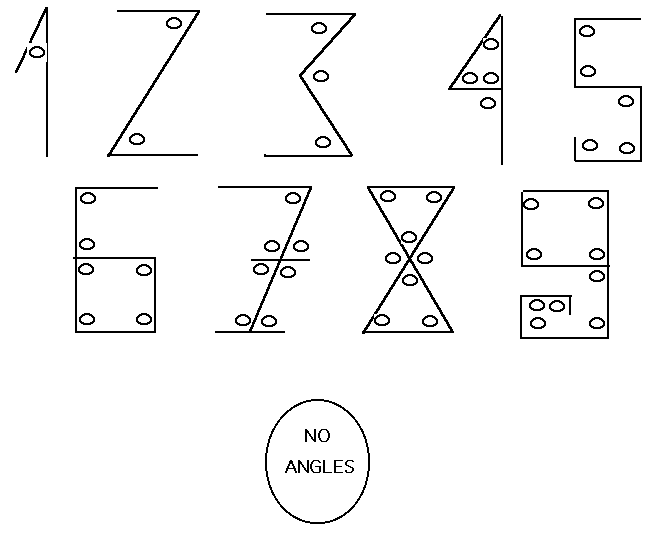
Have you ever thought why [the symbol] 1 means "one", and 2 means "two"? The Roman numerals are easy to understand but what was the logic behind the Phoenician numbers?
It's the number of angles. If one writes the numbers down (see below) on a piece of paper in their older forms, one quickly sees why. I have marked the angles with "o"s. No 1 has one angle. No 2 has two angles. No 3 has three angles. etc. and "0" has no angles
Interesting, isn't it? An ancient phonecian manuscript explains this and I thought it to be fascinating |
TOGGLE Editor's Note:
We seem to recollect being taught that the stroke through the seven, favored by Europeans, was to distinguish it from the character for "one" as well as to show that the written character for "seven" continues below the "line". Hmmm. Maybe so, but the Phoenicians apparently had a hand in it too, although the Europeans seem to have lost the bottom horizontal bar. This belief in the idea of distinguishing one character from another led also to engineers and mathematicians placing a horizontal stroke through the "Z" character (Zee to Americans, Zed to Europeans) to distinguish it from the number "2" in written formulae. Several years ago, we saw a reproduction of arabic script detailing accounts of trade and commerce of the day. The numeric symbols were fairly easy to recognize if you turned them sideways. The script for 2, for example, looked sort of like a capital N. Turn the N clockwise a quarter turn and you have the two angles of the number 2. I guess you could even write them upside down--as long as they have the right number of angles, they should not be misinterpreted. Notice that the horizontal line in the 4 does not cross the vertical line, otherwise it would have 6 angles. Notice also that the six is straight across the top, not "curled at the end" like the "tail" of the nine, so that, even if inverted, it would not be misread as a nine. When you are working with a convention that everyone understands and agrees to use, this works just fine. After all, you understood what I meant by clockwise didn't you? Such conventions, however, are sometimes shortlived or transitory in nature. We have noticed that our elementary-school-age grandchildren cannot readily tell the time-of-day unless there is a clock in the room with a digital read out. Is the analog clock soon to be a thing-of-the-past? Horrors! |
||
|
Number 200 - January 2000
|


|
||