 Number 209 - October 2000 |
| Logo Design - Part 2 | |
| by Gail Pittsford, Tacoma Open Group for Microcomputers | |
|
A logo should be designed
with the potential for a long life. Logos can date very quickly unless
the designer is careful. Although logo styles may need updating from
time to time, resist the urge to tinker unless it is really necessary.
Consumers are very conservative; it takes a long time to develop the
visual association; if you wish to update the visual meaning, you should
do it carefully and gently.
The function of the logo is to identify a particular product or company; therefore, the trademark or logo should be distinctive. If your logo is similar to others, it will not stand out. The design must also be sensitive to cultural norms: a jazzy electronic style would not be appropriate for a funeral parlor. 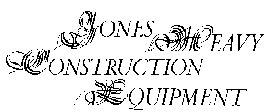
This flowing convoluted graphic style is inappropriate for a construction equipment company. A more robust style is called for.  
Name only Logos Name only logo styles derive their uniqueness exclusively from a name used in a particular graphic style. This is a simple, direct message with a lot to commend it. They are normally appropriate only when the name is relatively short and easy to use and when it is adaptable and relatively abstract.  
Name/Symbol Logos Name/Symbol Logos consist of the names in a characteristic type style contained within a simple visual symbol such as a circle, oval or a box.  
The name can also be presented in a distinctive visual symbol; the Levi logo resembles the patch pocket on a pair of jeans. The Nike logo visual element lends dynamism and energy.  
Initial Letter Logos When the name is multiword, such Universal Winding Company, it may be unwieldy and the company decides to use the initials alone like GM or IBM. It is difficult to invest initials with personality and distinctiveness. If the company is international the initials might vary from country to country. Initials can be successful as logos but need considerable exposure before they achieve recognition.  
|
Pictorial Name Logos
Composite name/design combinations form a distinctive logo style that has high recognition value. The name of the product or organization is an important component of the logo but the overall style is very distinctive.   
Associative Logos Associative logos are freestanding logos; they do not usually contain the product or company name, but they do have a direct association with the name. Examples are the shell logo of Shell Oil, the racing greyhound of Greyhound Corporation and the Michelin character built up from pneumatic tires. Associative logos must be easy to understand; the graphic device must represent the product or company in a simple and direct way.   
Allusive Logos The Mercedes "star" may allude to the spokes of a steering wheel. There is no doubt that the "A" logo of Alitalia, the Italian airline is designed to bring to mind the horizontal stabilizer of a jet. The Indian arrow head used by Anaconda alludes to early Indian copper mining. The connection between the name and the logo is not as direct as with associative logos and, in fact, the allusion may be lost on the majority of the audience. It is a fact that employees, customers, investors and other interested parties prefer a logo with some core of meaning over a purely abstract logo.  
Abstract Logos Abstract logos have become popular due to the diversified nature of many large corporations. Such corporations do not want a logo that refers only to one particular part, product or division. Abstract logos are fashionable and considered the quintessence of contemporary design. There will be some subtle associations such as a big rugged logo for a company making heavy construction equipment or an intricate, delicate logo for a textile company. Coming up with an abstract logo that is appealing yet distinctive is difficult.  
|
|
Number 209 - October 2000
|


|