 Number 233 - September 2002 |




|
| WebChalking | |
| excerpted from the TNT1 by Bob Thomson | |
|
In the June 2002 TOGGLE
newsletter and at the meeting we discussed the current WiFi craze that
is sweeping the ranks of Internet users who wish to set up a simple home
network. We also mentioned that anyone within about 300 feet of your
Access Point (transmitter) can join your network, if it is an open
network, and access the Internet through it.
In an article entitled "Internet users chalk up wireless networks" that appeared in the August 2, 2002 Tacoma News Tribube James Bickers of Gannett News Service wrote that, by marking pavements, buildings, telephone poles and the like with chalk symbols (what he called "Warchalking"), fans of WiFi can mark for others where to steal access to the Internet by piggy-backing on a local a user's WiFi home network. In the article Bickers wrote: "During the Great Depression, impoverished and homeless people across the country developed a language of symbols that would tell others where free food and lodging could be found. The symbols of this ''hobo language' were written on sidewalks, streets and the sides of buildings. "In recent months, a new 'street language' has quickly developed--one that tells Internet users where they can gain free Internet access. Arcane symbols written on sidewalks in chalk tell 'Wi-Fi-jackers' that they are near an open wireless network. "Wi-Fi jacking is the act of using (or stealing) someone else's wireless Internet access. It can be done legitimately--for instance, many coffee shops allow their patrons to use wireless networks in their stores--but it is mostly done by people with laptops who park themselves outside offices or on school campuses where wireless networks are used. "British Web designer Matt Jones, 30, with the help of a few friends, recently created the "warchalking" language, a series of chalk codes that tell users when they are near wireless networks. In the short time since warchalking appeared, it has spread like wildfire, particularly among Web users who maintain daily logs of their activity, called "blogs". [See They Call it Blogging p. 2, August 02 TOGGLE or click here] "While Net users might rejoice at the idea of free Internet access scattered throughout their town, security experts are quick to point out the downside. " Some business networks are recommending procedures to safeguard your WiFi network. Encryption and passwords would certainly seem a wise precaution to prevent misuse or even malicious damage to your WiFi Lan system. 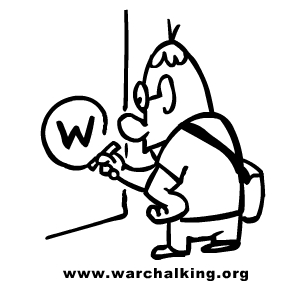
1 The (Tacoma) News Tribune (TNT) contributed additional information to this story. |
"In response, [to some
restrictive measures proposed by some Internet providers] the Electronic
Frontier Foundation, a nonprofit organization focusing on civil
liberties issues involving digital technology, is compiling a list of
Internet service providers that don't object to customers sharing Wi-Fi
networks.
"Despite the potential problems, Jones feels that warchalking--or some derivative of it--is here to stay. "'I think that community wireless will definitely get a whole lot bigger,' he said. 'I definitely think in some form that signage or visible indication in the landscape will be part of that.' "The name "warchalking"itself is the subject of some controversy among proponents. On the Web site www.warchalking.us, someone identified as Sid Kemp wrote, " 'Warchalking' makes people think of war. Yet this could be a cooperative effort. These signs could be posted intentionally, just like signs for handicapped parking spaces, public restrooms, and all kinds of other things... "'If we begin with an attitude of cooperation rather than war, we might be able to create an open wireless world. Two generations ago, neighbors came by to borrow a cup of sugar. Why can't they come by now, saying, 'I'm out of range for cellular data. Can I plug into your Wi-Fi?' And we can leave a sign at our door: 'I'm out right now, but feel free to sit on my porch and use my network.' "The poster proposed changing the name to 'webchalking.'. "And why chalk? "As Jones explained in one of the first stories about warchalking, on the Web site ZDNet.com, "Some people have asked why not use stickers or paint. But the idea of chalk means that people have to go around and renew the symbols, so the network is constantly revalidating itself and checking its own integrity." "And, he added, chalk marks on sidewalks or buildings shouldn't make too many people mad." 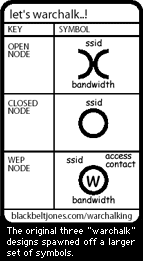
|
|
Number 233 - September 2002
|
|