 Number 254 - July 2004 |





|
| Decisions . . . Decisions Film v Digital | |
| by Marc Cohen, Danbury Area Computer Society | |
|
As a photographer both
amateur and professional, from high school thru a college degree,
military, corporate, advertising free-lancer, and on to my recent
retirement I have been a film, chemistry, and darkroom oriented
photographer. The rapid changes and the progression of Digital imagery
had me watching with amazement from the sidelines. A recent vacation
forced my hand; I decided it was time to take the plunge.
As recently as two years ago, a camera with a 1 megapixel resolution sensor was 'state of the art,' and sold for around $1000. Currently, the technology plunged thru 2, 3, 5, and 11 megapixel barriers and prices have dropped to as low as $49 at the lowest resolution range to $1500-$4500 at the upper limits. This for a camera equivalent to a 35 mm film camera in size or smaller. Let's ignore the digital backs and attachments available for the mid and large format cameras I previously used..... Shopping Last October I started looking for a camera in a 4-5 Megapixel range, with a price in the sub $1000 range... Internet searches helped me decide that I should look for a camera with a 5 or more optical zoom range. There are dust contamination considerations for choosing a camera with a fixed v interchangeable lens. (Dust affects only one frame of film at a time, but dust on a sensor remains, and requires either exotic methods to remove it or else it requires a return to the manufacturer.) Since digital zoom effects could be accomplished with almost any photo editing software, I learned that I could ignore all the advertisements touting in-camera digital zoom effects. I also knew that I did not want a shirt-pocket sized camera as I was used to the stability a heavier camera provided. I also wanted to be able to pickup and handle the camera before making a purchase, so it also had to be available locally. My final choice 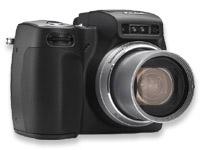
A less than $500 Kodak dx6490 camera purchased from the local Costco store. Although only a 4 megapixel sensor - the 10 x zoom lens was a deciding feature that won me over. The camera is a reasonable size and comfortable to hold. It has a fixed (10-1) Schneider Variogon zoom lens, equiv- alent to a 38-380 mm lens on a 35mm film camera. Accessory wide angle and telephoto supplementary lenses are available. The camera also allows a choice of full automatic or manual focus and exposure control. The price includes a relatively powerful 1700 mAh Li-ion battery and a recharging dock with a power |
cable. Also included also are a pair of
cables, a USB cable for connection to the computer, and a cable to
connect to a TV. Included is a CD 'KodakEasy/Share' software. (I haven't
yet had the time to investigate the program.) The only additional
purchase required were two 256MB SD/MMC chips to store images until I
could get to a place to burn them to a CD. A 256MB chip can store 192
photos at the highest resolution or 16 minutes of video and sound, or a
lesser mix of both.
In use I had the camera for about a week, before leaving on a five week trip to Hong Kong and Thailand. I just had time to familiarize myself with the features of the camera, taking a few test pictures and videos around the house, some interior and some outdoor shots, with and without the built in flash, some long shots and close up and macro shots, burn a disk, and view them on the computer and TV. I reformatted the chips and we were off. In use the battery permitted several days of shooting without the necessity of a recharge (good thing, because we were sometimes beyond the power network). The two chips were filling up rapidly. In Thailand there were many internet cafes some of them could unload the chips to a CD and also print some of the photos I had promised a grade school class in a small village we had visited. With the two chips now empty, I was ready for another 380 shots..... The ink jet prints from the internet cafe were the first I had seen printed from the camera as I didn't, and still don't have a color printer. I was impressed. At a 4x6 inch print size the colors were more intense than film and they looked as sharp as the same sized film prints. Upon arriving home I took the refilled chips and the CD made in Thailand to the local Walgreen, and spent a few hours playing with the photos on their digital printing machinery. Walgreen transferred the selected images to a processing machine and printed out the 500 plus photos on photographic paper processed in photo chemistry (not ink jet). Such prints have a longer life than ink jet prints. I have to say the print quality was great, and at 20 cents each they are, I think, cheaper than printing on an ink jet at home. Walgreen's price also included burning all the images to CDs. The CDs have one of the easiest slide show presentations I had ever been able to get to my TV.... Next, I will be looking at photo quality color printers. This will be a continuing learning adventure. MARC COHEN is a founding member, a DACS director and production editor of dacs.doc. A perpetual novice, he started out having problems with C/PM on his Osborne computer, and still has problems with Windows. |
|
Number 254 - July 2004
|
|